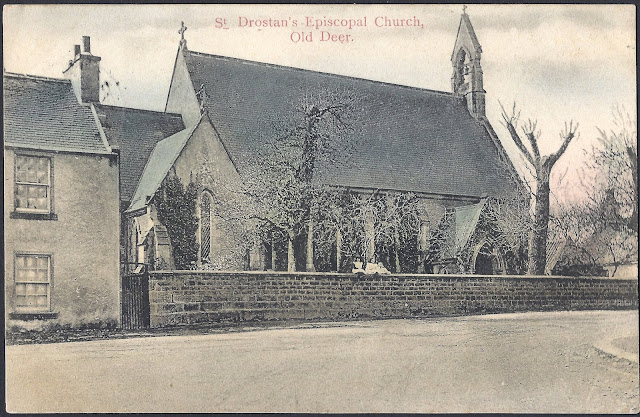
I established this new weblog with one simple purpose: to create a means of wandering through Scotland's landscape and history by using interesting postal items. I know that this simple constitutional rule will eventually spin out of control, either by me zooming in too much on the philatelic part of the story or by omitting Scotland in several successive logs because my interest shifted towards other area's (both philatelicly and geographically speaking). In both cases (or should I say in
all cases) I, the author, am to blame. If you feel, or rather think this blog is slowly turning into a potpourri which at first stealthily lures you into a wondrous, omniscient world but at second thought learns you nothing: contact me. Then, obviously, I've dropped several stitches in the fabric of this weblog. When you feel at lost in this inscrutable jungle of facts I generated, please give your opinion also! Although I try to stick to the subject most of times, at rare occasions I cannot grasp for any words. Then the opposite happens: I will grasp for words upon a subject will follow. A recipe ripe for disaster...at least if you're not a demagogue or lawyer.
Colonsay
Well, to take off from this philosophical prologue I've made a scan of a rather attractive photo postcard I have in my collection. It shows you the Scalasaig Hotel on the Isle of Colonsay: a small relatively flat island in the western inner Hebrides. In 1931 only 232 souls inhabited the island, since then the population steadily declined to about 100 people living there in 2001. From 1905 onwards the island has been the property of successive lords Strathcona and Mount Royal. During summer the island is served by a daily ferry service from Oban (takes 2 hours and 20 minutes) and a twice-weekly ferry service from Islay (70 minutes), the latter only faring in summertime. When winter arrives the ferry only runs on Mon-, Wednes-, and Fridays. The island also maintains a small airport from which you can fly to Oban and Islay.
 |
| The harbour and pier of Colonsay, a place called Scalasaig. |
The main settlement lies on the east coast of the island and functions as central hub from which the ferry departs and where supplies are delivered. The Scalasaig Hotel as is displayed on the photo postcard above was built in 1750 and probably diverted many islander's thoughts from their misery existence over 100s of years. Today the hotel still exists, only being renamed as the Colonsay Hotel.
 |
| Map of Colonsay published around 1930 |
I would digress about the complete history of the island, if this wouldn't have been my first post in which I only *just* adopted my severe guidelines. So, let's have a quick glance at the reverse (which I think is even more interesting...).
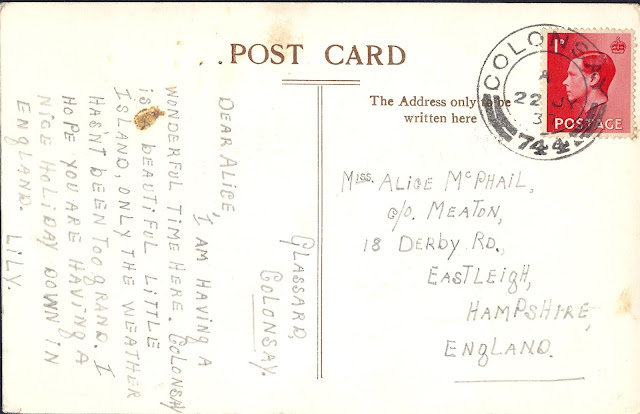 |
| Colonsay 744 CDS double arc on 1d Edward VIII ~ 22-07-1937 |
In August 1903 the post office on the island became a sub-post office and was granted the status as post town, prior to that date the post office fell within the post town district of Greenock near Glasgow. According to the text - obviously written by a child - the sender enjoyed her holiday just north of Scalasaig in a hamlet called Glassard. Still, even a postcard sent from the island of Colonsay isn't that rare. Considering a population of 200 people and a few tourists in the summer of 1937 there would have existed several outgoing postal items every day (if the ferry ran). And so every summer in the 1920s, 1930s, 1940s etc. would have seen a small increase of 'holiday mail'.
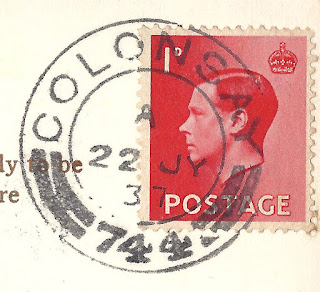 |
| Edward VIII 1d tied by a Colonsay 744 CDS |
When a definitive becomes rare...
What really interested me though is not only the card and postmark, but foremost the stamp: it shows King Edward VIII, yes that's the one who abdicated his throne within a year over his girlfriend. Upon his father's death on 20 January 1936 Edward became king by primogeniture. It took 6 whole months to design, press and release a simple set of 4 stamps. On the 1st of September the first 3 appeared and slowly they found their way to all (sub-) post office across the UK. Edward abdicated the throne on the 10th of December 1936, making his brother King George VI. It took the Royal Mail 5 months to release stamps bearing the image of the 3rd UK monarch of 1936. Happily he occupied his throne considerably longer than his brother. The remaining stamps (from sheets) of Edward VIII were pulled back on June 29 1937. I should note though that stamps bearing his image were only invalidated when the decimal system was introduced in 1971.
So now we remain with one last question: how many sheets of 1d Edwards were sent to Colonsay? Sheets contained 240 stamps each. The red 1d stamp was primarily used for inland postcard rates, so on postal items it is probably the most common of Edward VIII stamps. Postcards are much easier to store and were back then indeed far more collectible than letters. Still, let's assume the 1d sheets arrived on Colonsay somewhere in late 1936 there surely wouldn't have been more than 5 postcards sent from the island each day (especially not during the winter). Only in the summer of 1937 the amount of postcards would have seen a small increase, but even then I don't see a population (including tourists) of a little more than 200 souls sending over 10-15 postcards each day.
Surely by December 1937 the island would have had the new George VI stamps, so let's say the Edward VIII 1d stamp was in use for a whole year and dividing this year in half (5 postcards during the winter, 15 during summer) I estimate that about 3750 postcards could have been sent from the island bearing an Edward VIII 1d stamp. Seeing that number I still think it is a grossly overestimated figure. My gut feeling says that it would have been half of that or even less. Still, we will use this overestimate. From these 3750 used on Colonsay 1d stamps only 10% would have survived. That's largely due to the specialty of the place. Postcards from islands were (and are still) very popular amongst collectors. Most of times less than 1-2½% survives of the total amounts of postcards from more common places.
Then still only about 370 Edward VIII postcards would have survived, most of them tugged away in collections. That's about the same number of letters recovered from the Hindenburg Zeppelin crash in the same year, each of them being sold for over $5000,- at auctions today. Well, of course that's a totally different story, but it gives you at least an indication how small the number is. And, as I've been saying, I think the amount of postcards which have actually having been sent from Colonsay is lower still. So I guess I own a proper valuable item then: I might consign it to a rarity auction some day ;)